Creator Economy· Gids
Starting print-on-demand: how it works and what are the costs and risks
Print-on-demand enables you to run a web shop without stock. Products are only made after an order is placed. How does this model work, what costs does it involve and what should you watch out for?
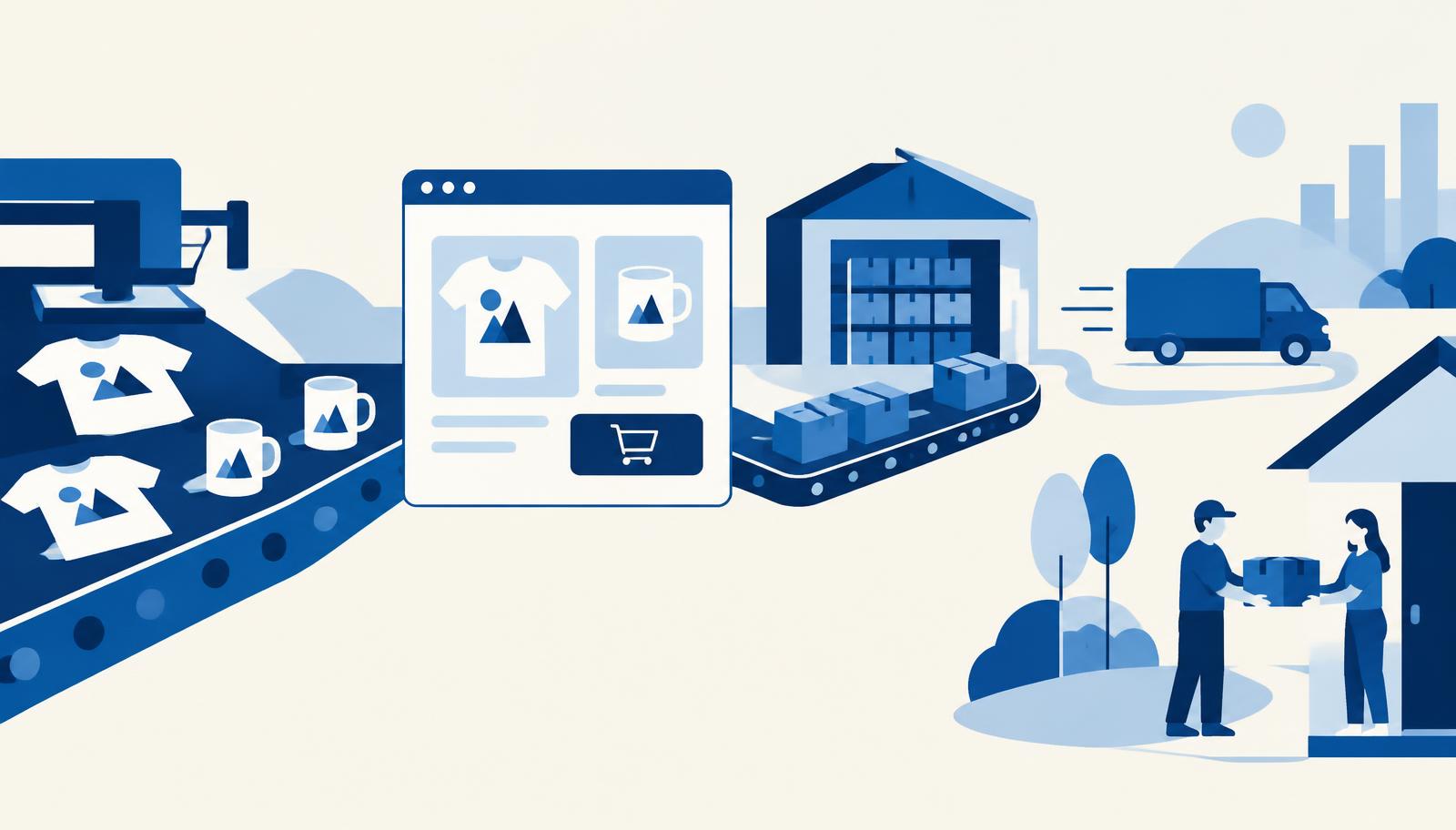
Short answer: Print-on-demand (POD) is a dropshipping model where products are only printed after a customer places an order, meaning you don't need to hold stock. Platforms like Printify are free to use; you only pay for production and shipping of items actually sold.
What is print-on-demand?
Print-on-demand (POD) is, according to Printify, a dropshipping business model where products are only printed after a customer places an order [1]. This makes it possible to run an e-commerce business without holding stock [1].
Unlike traditional production, no large upfront investments are required and you don't need to place bulk orders [1]. With Printify, your chosen print partner produces and ships each order directly to your customer as soon as it's placed, so you only pay for what actually sells [1].
How does print-on-demand work?
Printify connects your online shop with a global network of print partners who produce and ship each order on demand [1]. The platform handles production and fulfilment, allowing you to focus on design, marketing and sales [1].
Steps to get started
- Create a free account with a print-on-demand platform
- Connect your web shop to the platform
- Use the design tool to create products
- Set your selling prices
- When a customer orders, the order automatically goes to the print partner
- The print partner produces the item and ships it directly to your customer
You don't need to make any upfront payments to design products and list them in your shop [1]. Only when a customer makes a purchase are production and shipping costs charged.
Print-on-demand versus traditional production
Traditional methods like screen printing often require bulk purchases to keep per-item costs low, which means you risk financially on everything that doesn't sell [1]. Print-on-demand eliminates that risk [1].
Printify uses printing methods such as direct-to-garment (DTG) and all-over printing (AOP) to produce high-quality, individual items after a customer makes a purchase [1]. That means no upfront stock costs, no unsold inventory to manage, and more room to focus on design and growing your brand instead of managing a warehouse [1].
Costs of print-on-demand
Printify platform costs
Using Printify is free [1]. You can create an account, connect your shop and use the Product Creator to design products without upfront payment [1]. You only pay for production and shipping once an order actually comes in [1].
If you want to save more per sale as you scale, Printify Premium offers discounts on production costs for a subscription fee [1]. The exact amount of this subscription fee is not stated on the official site.
Production and shipping costs
Production and shipping costs are charged per order and depend on the chosen product, print partner and destination. Specific prices per product category are not mentioned in the provided sources.
For information about profit margins, Printify refers to a separate guide about how much you earn per sale [1], but these details are not in the provided source texts.
Advantages of print-on-demand
- No stock risk: You don't need to buy products in stock that might not sell
- Low start-up costs: No large upfront investments required [1]
- No warehouse management: Products are shipped directly to customers
- Flexibility: You can easily test new designs without financial risk
- Scalability: You can start with one product and expand without additional infrastructure
- Focus on creativity: More time for design and marketing instead of logistics [1]
Limitations and risks
No control over production
You depend on the print partner for product quality and delivery times. If problems arise in the production process, this can damage your reputation whilst you have no direct control.
Lower profit margins
Because you produce per item instead of in bulk, production costs per item are higher than with traditional production [1]. This means your profit margins can be smaller, especially if you compete on price.
No stock means no direct quality control
You cannot physically inspect products before they go to customers. It's therefore wise to order samples first to verify quality.
Dependence on third parties
If your print partner has technical problems, is out of stock of certain items, or experiences other disruptions, this directly affects your ability to deliver to customers.
Practical tips for beginners
Start with a niche: Focus on a specific target audience or theme instead of wanting to be everything to everyone. This makes marketing more effective.
Test designs: Because there are no stock costs, you can test different designs to see what resonates with your audience before investing heavily in marketing.
Order samples: Before launching your product, order copies for yourself to check quality, colours and print quality.
Calculate your prices carefully: Take into account production costs, shipping costs, platform costs, marketing expenses and desired profit margin. Printify refers to specific tools for profit calculation [1].
Choose reliable print partners: Research reviews and delivery times of different print partners within the network.
Be transparent about delivery times: Print-on-demand products have longer production times than items already in stock. Communicate this clearly to customers.
Frequently asked questions
Do I need to pay to start with Printify?
No, using Printify is free [1]. You can create an account, connect your shop and design products without upfront payment [1]. You only pay for production and shipping when an order actually comes in [1].
What's the difference between print-on-demand and traditional production?
Traditional methods like screen printing often require bulk purchases to keep per-item costs low, which means financial risk on everything that doesn't sell [1]. Print-on-demand eliminates that risk because products are only made after a customer order [1].
Which printing methods are used?
Printify uses printing methods such as direct-to-garment (DTG) and all-over printing (AOP) to produce high-quality, individual items [1]. These methods make it possible to produce on demand without minimum order quantities.
How do I earn money with print-on-demand?
You set your own selling prices. The difference between what you charge customers and what you pay for production and shipping is your profit. Printify offers tools to calculate how much you earn per sale [1], with Printify Premium offering additional discounts on production costs for subscribers [1].
Read also
- Dropshipping voor webshops: hoe werkt het met Droppery?
- Clipping versus UGC: de verschillen voor merken en creators
- Wat is clipping? Zo werken korte video's en vergoeding per gekwalificeerde views
- Alles over Creator Economy
- AI-tools in onze toolgids
Sources
1. Printify — What is Print on Demand?
2. Printful — How Printful works
Sources
This article was produced with AI assistance from the original sources cited and checked against our editorial policy. Editorial policy