Creator Economy· Gids
What is clipping? How short videos and payment per qualified views work
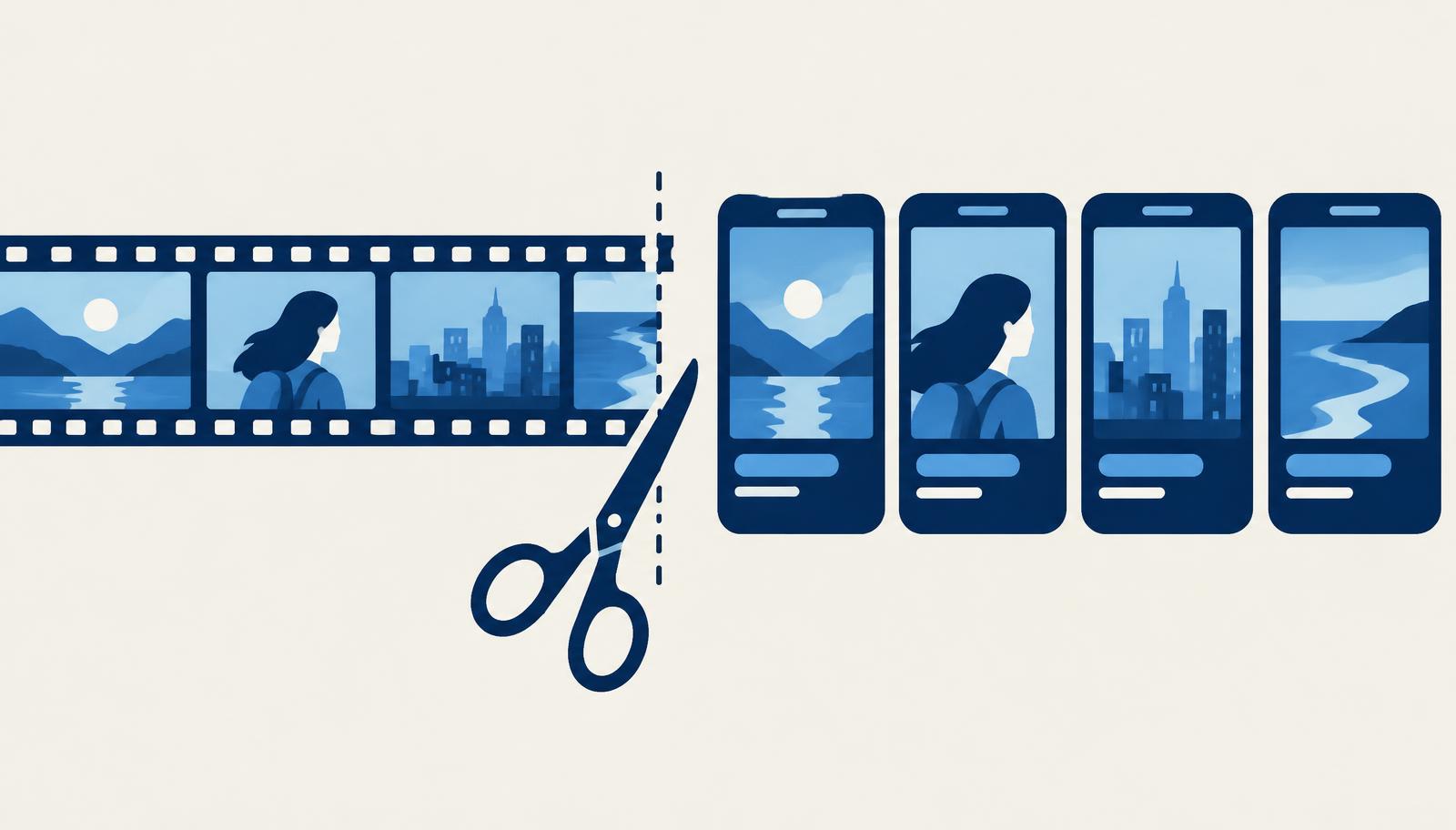
Clipping is cutting strong moments from long videos and distributing them as short content on TikTok, Reels and Shorts. On CLIPPERY Marketplace you receive payment per 1,000 qualified views – no income guarantee, but performance-based rewards.
Short answer: Clipping is selecting powerful fragments from long videos – podcasts, livestreams, interviews – and transforming them into short, vertical videos for TikTok, Instagram Reels and YouTube Shorts. On platforms like CLIPPERY Marketplace you work with campaigns from brands and creators and receive payment per 1,000 qualified views, without guarantee but based on your results [1][4].
What is clipping?
A long video often contains a handful of moments that can stand alone: a sharp opinion, a funny reaction, a clear explanation [1]. Clipping is finding, cutting and shaping those moments into short videos that fit how people watch on their phones [1]. A good clip usually lasts fifteen to sixty seconds, is vertical (9:16 format), has subtitles and opens with a hook that makes clear within the first seconds why you should keep watching [1].
Clipping differs from general video editing. Video editing is the broad field – cutting, colour, sound and effects, from short adverts to complete films. Clipping is one specific form of it with one goal: converting existing material into short videos that perform on social platforms [1]. A clipper spends as much effort on selection and distribution as on the editing itself; the core skill is recognising the right moment [1].
How does clipping work? Steps from source to publication
The process broadly always follows the same pattern [1]:
- Choose source material for which you have permission to clip.
- Find the moment: a fragment that makes sense without extra context.
- Cut and edit: reframe vertically, tighten the pace, add subtitles and a title or hook.
- Publish the clip on the platform it was made for.
- Measure views and reactions and learn what works.
Material with lots of speech and clear statements often performs well, because a single sentence can carry a powerful clip [1].
What is a clipper?
A clipper converts others' long-form content into short videos and distributes them via their own social accounts [1]. Where an influencer primarily sells their own face and audience, a clipper works with the material: the brand or creator supplies the content, the clipper supplies the format and distribution [1]. You don't need a large following – on TikTok, Reels and Shorts each clip gets its own chance to be picked up, regardless of your follower count [1].
How can you earn money from clipping?
The most common model is performance-based payment: a brand pays a fixed amount per 1,000 views a clip achieves [1]. You're paid for the result a video delivers, not for every video you make [1]. Some creators and brands also hire clippers on retainer or per commission; CLIPPERY Marketplace works with campaigns where each campaign has its own rate, rules and budget [1].
Example: At £2.50 per 1,000 qualified views, a clip with 40,000 qualified views generates £100. The same clip at 2,000 views generates £5 – or nothing, if the campaign has a minimum of 5,000 views [1]. Income is never guaranteed; it depends on your clips, the platform, the campaign conditions and the remaining budget [1]. When the budget runs out, the campaign stops paying [1].
How does clipping work on CLIPPERY Marketplace?
Brands and creators publish campaigns on CLIPPERY Marketplace [1][2]. Before you start, each campaign shows the rate per 1,000 qualified views, which platforms count, possibly a minimum number of views per clip, possibly a maximum per clipper and how much budget remains [1][4].
The five steps [1]:
- Choose a campaign and read the brief and conditions.
- Make your clip from the supplied source material – with CLIPPERY's Clipping tool or your own editor.
- Post it on an allowed platform and submit it to the campaign.
- The company reviews your submission. Once approved, your qualified views count.
- Your earnings grow with your views until the campaign budget or your per-clipper limit is reached.
All open campaigns show in real-time how much budget remains [4].
Which videos can you clip?
Only videos for which you have permission [1]. In a CLIPPERY campaign, that's the source material the brand or creator provides [1]. Typical examples: podcast episodes, livestreams, interviews, lectures, behind-the-scenes footage and product videos [1].
Clipping random videos from the internet without permission and earning money from them can violate copyright and image rights, and often leads to removed posts or blocked accounts [1]. In a CLIPPERY campaign, the brand or creator supplies the source material together with usage rules; stick to them: use the material only for that campaign, don't change the message, and don't add any imagery or music you don't have rights to [1].
Clipping for TikTok, Instagram Reels and YouTube Shorts
All three are vertical, short and autoplay, but each has its own feel [1]. On TikTok the opening matters even more; Reels suits a polished, visual style and is often discovered via Explore; YouTube Shorts rewards clear subjects and can direct viewers to longer videos [1]. Each campaign lists the platforms where clips count – only post there if you want to earn from that campaign [1].
What are qualified views?
A qualified view is a view that counts towards the reward under the campaign's conditions [1]. Broadly speaking: the clip is public on an allowed platform, belongs to an approved submission and follows the brief [1]. Purchased or artificial views never count [1]. Some campaigns have a minimum: a clip only starts counting from a certain number of views; this is always shown in advance on the campaign [1].
Benefits of clipping for brands
Brands often sit on content that's used once [1]. Clipping gives that material a second life distributed across many accounts simultaneously [1]. Because you pay per qualified view, you pay for results instead of production hours [1]. On CLIPPERY Marketplace a brand sets its own rate, minimum views and budget, and reviews each submission before it counts – so the brand stays in control of how it's presented [1].
How do you start as a clipper without experience?
You don't need professional equipment [1]. A phone or laptop and an account on TikTok, Instagram or YouTube is enough to start [1].
Steps for beginners [1]:
- Start with one campaign and read the brief carefully.
- Watch the full source and note the moments you'd share yourself.
- Make a few short versions and compare their opening lines.
- Always add subtitles – many people watch with sound off.
- Check after a few days which clips performed best and learn from them.
Registration and browsing campaigns is free for clippers [1].
Limitations and risks
No income guarantee: Income depends on your clips, the platform, the campaign conditions and the remaining budget [1]. When the budget runs out, the campaign stops paying [1].
Copyright and permission: You may only use material for which you have permission; without that permission you risk having your posts removed or your account blocked [1].
Platform rules: Your use of Output remains subject to the terms of the platforms where you publish [3].
AI and subjective quality: If you use CLIPPERY's Clipping tool (which uses AI), the platform gives no guarantee that Output will meet your expectations, taste, aesthetic or technical quality level, or be suitable for a particular purpose [3]. Dissatisfaction with a successfully produced result gives no right to a refund [3].
Multiple clips: You can make multiple clips for one campaign, provided the campaign allows this; some campaigns have a maximum per clipper [1].
Frequently asked questions
Is clipping legal?
Yes, as long as you have permission from whoever owns the material [1]. In CLIPPERY Marketplace campaigns, the brand or creator supplies the material precisely for that purpose [1].
Do I need many followers to earn?
No [1]. On short-video platforms each video gets its own chance; you earn on qualified views per clip, not on your follower count [1].
Does it cost anything to become a clipper on CLIPPERY?
No [1]. Registration and browsing campaigns is free for clippers [1].
When do I get paid?
After your submission is approved and your qualified views are confirmed, according to the campaign conditions [1]. You can track your earnings in your CLIPPERY account [1].
What happens if the campaign budget runs out?
The campaign stops paying for new views [1]. Each campaign shows how much budget remains [1][4].
Read also
- Dropshipping for webshops: how does it work with Droppery?
- Starting print-on-demand: how it works and what are the costs and risks
- Best tools for short AI videos and clipping: official features compared
- Everything about Creator Economy
- AI tools in our tool guide
Sources
1. CLIPPERY — What is clipping?
2. CLIPPERY — About CLIPPERY
3. CLIPPERY — CLIPPERY Terms
4. CLIPPERY — CLIPPERY Marketplace
Transparency: AI Up to Date may have an editorial/commercial relationship with CLIPPERY (clippery.io).
Sources
- [1]CLIPPERY: What is clipping?
- [2]CLIPPERY: About CLIPPERY
- [3]CLIPPERY: CLIPPERY Terms
- [4]CLIPPERY: CLIPPERY Marketplace
This article was produced with AI assistance from the original sources cited and checked against our editorial policy. Editorial policy